
Home › Newsroom › monetisation
monetisation
Compare Short Drama Platform Costs and Free Episode Allowances
Comparing short drama platform costs means looking at what viewers pay — free episode limits, coin packs, subscriptions and ads — and what you pay to operate the service. A generous free allowance can help discovery, or it can train people never to buy.
Comparing short drama platform costs means looking at what viewers pay — free episode limits, coin packs, subscriptions and ads — and what you pay to operate the service. A generous free allowance can help discovery and still leave a cliffhanger; it can also train people never to buy. Industry trackers have published large US in-app totals, but monthly figures vary by source, and they are not a forecast for your catalogue.
Dramnex OS starts with a free 7-day trial and paid Creator, Starter, Launch and Studio plans. Network is a legacy option and is not listed as a current plan. See current pricing and how much it costs to start a streaming service.
Key Takeaways
- Set the free-episode cutoff where it gives viewers a clear sample, then assess how coin unlocks shape the path to paid viewing.
- Compare ad-supported, in-app purchase, and hybrid models by how each earns revenue and affects the viewing experience.
- Judge subscriptions by the access they provide, such as ad-free viewing, unlimited episodes, early releases, or exclusive content.
- Match your monetization setup to your launch plan, then use the comparison criteria to identify which costs and trade-offs matter most.
Table of contents
- How do free episode allowances work?
- How do advertising, in-app purchases and hybrid models compare?
- How should you compare the cost of short drama platforms?
- How much do short drama apps charge for a monthly subscription?
- How Dramnex OS prices the platform and the viewer experience
How do free episode allowances work?
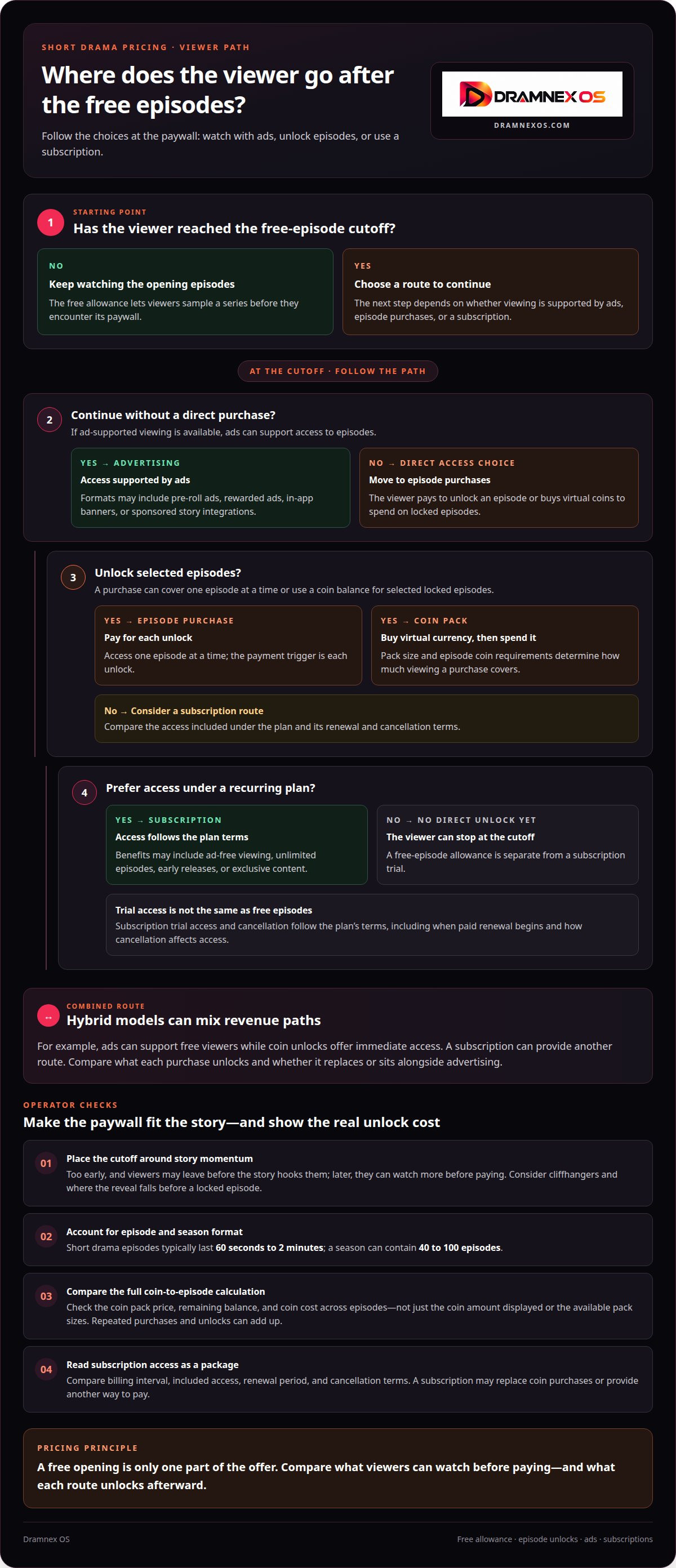
Some short drama apps let viewers watch the opening episodes free, then require virtual coins to unlock more. This sample lets viewers try a series before reaching its paywall. For operators, the cutoff shapes the first purchase decision: set it too early and viewers may leave before the story hooks them; set it later and they can watch more before paying.
Coins separate the displayed purchase from the cost of unlocking an episode. Viewers buy a coin pack, then spend coins on individual episodes. The pack size and coin requirement determine how much viewing a purchase covers. For example, a small balance left after an unlock may affect whether viewers buy again. Compare the coin cost across episodes, not just the available packs.
Format affects that calculation. Short drama episodes typically last 60 seconds to two minutes, while a season can contain 40 to 100 episodes. A Chinese-style cliffhanger format may place a reveal just before a locked episode. Measure where viewers encounter the paywall against the story’s momentum, not only the number of free episodes.
A free trial applies to a subscription, not to a free-episode allowance. Trial access and cancellation follow the subscription terms, including when paid renewal begins and how cancellation affects access.
| Option | Viewer access | Payment trigger | Best fit |
|---|---|---|---|
| Free episodes | Opening episodes | Reaching the cutoff | Sampling a series |
| Coin pack | Selected locked episodes | Buying virtual currency | Flexible viewing |
| Per-episode unlock | One episode at a time | Each unlock | Targeted continuation |
| Advertising | Access supported by ads | Ad viewing | Ad-tolerant viewers |
| Subscription | Access under plan terms | Trial end or renewal | Regular viewing |
Choose a setup by matching the free cutoff, coin pack value, and episode unlock cost to your series’ storytelling rhythm. That is the practical core of short drama platform pricing.
How do advertising, in-app purchases and hybrid models compare?
Drama apps can earn through advertising, viewer purchases, subscriptions, or a hybrid mix. In the United States, short-drama platforms have been reported, in secondary industry write-ups, as generating around $58 million in US in-app revenue in May 2025. Treat that monthly figure as directional: methods vary, and a matching primary tracker page was not available to confirm the exact amount.
Are there extra charges or risks with in-app purchases on short drama apps? Yes. Repeated coin purchases and episode unlocks can add up, so compare the coin pack price with the episodes it unlocks before buying.
How do in-app purchases work with freemium viewing?
Freemium viewing gives viewers some entertainment at no charge, then charges for additional access through coins, episode purchases, or a subscription. Advertising can support free viewing through pre-roll ads, rewarded ads, in-app banners, or sponsored story integrations.
Unlike advertising alone, in-app purchases tie revenue to a viewer’s choice to unlock or buy. Track the full purchase flow: the coin pack, balance, and unlock cost. This shows the effective cost of continuing a story more clearly than displaying a coin amount alone.
How do hybrid models affect platform pricing?
A hybrid model combines revenue sources, such as advertising for free viewers and coin unlocks for those who want immediate access. A subscription can offer another route, potentially providing ad-free viewing, unlimited episodes, early releases, or exclusive content.
Compare GoodShort and ReelShort based on the options shown to viewers: free access, ads, episode purchases, coin packs, and subscription entitlements. Don’t assume their pricing works the same way. Record what each purchase unlocks and whether it replaces or sits alongside advertising. This creates a useful comparison without treating one app’s setup as typical.
Choose based on the balance you want between ad-supported reach and direct viewer spending. For operators planning their own coin and episode-unlock setup, white-label streaming controls connect those choices to a branded app.
How should you compare the cost of short drama platforms?
Compare subscription access separately from the cost of operating a streaming service. Weekly, monthly, and annual billing affect how viewers commit, while content, audience, and monetization shape an operator’s budget.
What do monthly subscription costs look like?
A monthly subscription gives viewers access for a recurring billing period. Compare the included benefits, such as ad-free viewing, unlimited episodes, early releases, or exclusive content. These features determine whether a subscription replaces coin purchases or adds another way to pay.
For operators, separate viewer subscription charges from platform operating costs. Build a comparison sheet with platform plan, content licensing, app setup, and monetization tools as distinct rows, then note what each option includes. This prevents a low entry price from obscuring a missing capability or a separate cost driver.
How do weekly, monthly and annual plans compare?
Short drama subscriptions may use weekly, monthly, or annual billing. There is no single billing interval to assume across apps. Compare the renewal period, included library access, and cancellation terms shown with each plan.
A weekly option may suit viewers testing a service, while monthly billing allows more time to evaluate it. Annual billing requires a longer commitment, so weigh its full term against expected viewing and the library’s appeal. For operators, the billing interval affects revenue timing, not just the plan label.
Do short drama platforms offer weekly, monthly, or annual plans? Some apps may offer these intervals, but options vary by service. Compare the exact term and included access instead of assuming every app has all three.
Use this sequence to assess a streaming offer:
- Separate viewer subscription charges from platform costs.
- List what access includes, such as ad-free viewing or early releases.
- Compare billing interval, renewal terms, and library fit.
- Factor in production and licensing needs for the audience you want to reach.
Vertical stories designed for short viewing sessions can support different monetization choices from long-form streaming. Match the plan to your audience’s viewing habits, then check whether the library can encourage repeat engagement. Downloads alone don’t show whether a subscription offers enough value to retain viewers.
How much do short drama apps charge for a monthly subscription?
There isn’t one monthly subscription amount across short drama apps. Compare what each plan includes: ad-free viewing, unlimited episode access, early releases, and exclusive content can all change the value viewers receive.
Compare a subscription with the alternatives in the same app. Viewers who watch only a few episodes may prefer individual unlocks; regular viewers may value a subscription that bundles broader access. Advertising can support viewing without a subscription, but changes the experience through pre-rolls, rewarded ads, banners, or sponsored story integrations.
Use this check before choosing a plan:
- Access: Does it include unlimited episodes, selected series, or early releases?
- Viewing: Does the subscription remove advertising or leave ads in place?
- Payment: Is access subscription-based, coin-based, or a mix?
- Fit: Does the library offer enough stories for the viewer’s expected use?
For example, compare a plan offering ad-free viewing with one offering early releases. The better fit depends on whether a viewer values uninterrupted streaming or earlier access to new episodes. Compare those benefits directly instead of judging a subscription by its monthly label alone.
Operators should also separate viewer charges from platform launch costs. A viewer subscription is one revenue model; production, licensing, and app setup are separate planning factors. Give each its own budget line, then compare the subscription features with your intended audience and library.
That’s the practical test for short drama platform pricing: weigh the access included against the viewing pattern you want to serve. If you’re planning a branded streaming launch, map subscription choices to your launch model before settling on the mix.
How Dramnex OS prices the platform and the viewer experience
Viewers get a branded web app they can install from the browser as a PWA. Dramnex OS does not provide native iOS or Android apps, and it does not list apps on the App Store or Google Play. There is a free 7-day trial with no card. Trial storefronts show a “Made with Dramnexos.com” watermark, which comes off on a paid plan. Plans are Creator at $49/month, Starter at $149.99/month, Launch at $399/month and Studio at $999/month, plus a 5% platform fee on collected viewer payments (0% during the trial). See current pricing. Viewer payments go to the operator’s Stripe account once Stripe is connected. Until then, Dramnex OS can collect payments and pay out by Wise (including to a Pakistani bank in PKR), Payoneer, PayPal, or bank transfer. Stripe’s processing fee is separate. Done-For-You Launch is optional setup help: branding, custom domain, catalog onboarding, and monetization configuration. It does not include native app development or store listings.
You can start a free 7-day trial, open the self-serve demo, or browse finished series on the content marketplace.
Related reading
FAQ
Frequently asked questions
How do coins work in short drama apps?
Viewers buy a coin pack, then spend coins to unlock episodes or titles. The pack price and the per-episode cost should be visible before purchase, and unused-coin terms should be stated in the app.
What is the most a short drama app can charge for one purchase?
Store and processor limits apply, and they change. There is no single industry cap you can copy. Set pack sizes you can explain, and confirm current limits with your payment provider or store.
How much does it cost to unlock individual episodes?
It varies by app, title and whether a pack discount applies. Compare the coin-pack price with the number of episodes it actually unlocks, not only the headline coin count.
Are short drama app prices different on iPhone and Android?
They can be, because store billing, taxes and regional price tiers differ. A web-billed PWA can show one price on your site, subject to tax and processor rules, without store IAP tiers.
How should you set a free episode allowance?
Give enough of the story to hook a viewer, and stop at a point where continuing still matters. Too few free episodes can stall discovery; too many can remove the reason to pay. Test the cutoff with your own completion and purchase data.
What does it cost to operate a storefront on Dramnex OS?
Plans are Creator at $49/month, Starter at $149.99/month, Launch at $399/month and Studio at $999/month, plus a 5% platform fee on collected viewer payments (0% during a free 7-day trial with no card). Network is a legacy option and is not listed as a current plan.
Newsroom by email
Get new articles in your inbox
Guides on launching and monetising your vertical-drama business. Confirm your address once, and we’ll email you when a new article is published.
Launch your own
Your own branded streaming app, live in minutes
Dramnexos is the white-label streaming operating system for vertical drama: your brand, your domain, coins, VIP and episode unlocks — with a free storefront to start and a licensing marketplace for finished series.