
licensing
Finished Short Drama Series Licensing: Terms, Rights, and Delivery
Licensing a finished short drama series means buying defined rights to a completed title, not commissioning a new one. Agree the territory, exclusivity, term, platforms and delivery materials in writing before you buy, and check that the masters actually fit your release plan.
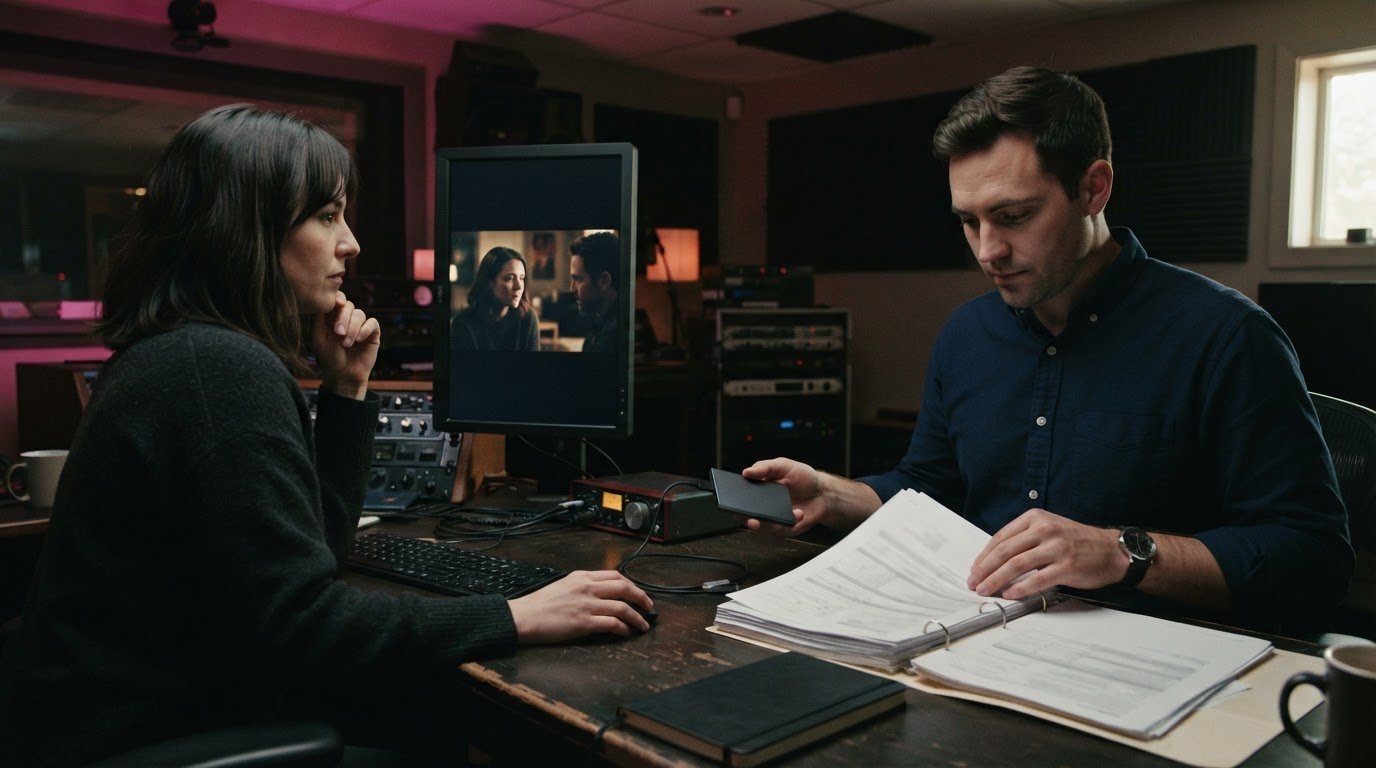
Licensing a finished short drama series means the rights holder lets a buyer distribute a completed title under written terms — territory, exclusivity, duration, platforms and delivery materials — rather than commissioning a new production. Get those terms and the files right before you buy, because a finished series still needs title-by-title rights evidence and masters that fit your release plan. This guide covers what to clear, how the commercial terms work, and how to use a content marketplace to compare titles against the licence, not as two separate decisions. In the United States, copyright gives the owner exclusive rights in the work, and using it usually requires permission from the rights holder (U.S. Copyright Office, What is Copyright?).
Key Takeaways
- Match the licence to your release plan: territory, exclusivity, term, and episode volume all shape the deal.
- Non-exclusive rights are a practical starting point; territorial exclusivity can cost more, while worldwide exclusivity can be hard to obtain for titles that have already been released.
- Plan payment and localisation together. Many first-time deals ask for payment on or before delivery, and episode count can affect acquisition and dubbing costs.
- Use catalogue access to compare finished titles against your app’s audience and release needs before committing to a licence.
Table of contents
- What delivery specifications and rights should you clear?
- How do territory, exclusivity, term and payment shape the deal?
- How do you access a catalogue and make a licensing inquiry?
- What should a finished microdrama catalogue include?
- How can Dramnex OS help you license finished series?
- What should you do after you license a title?
What delivery specifications and rights should you clear?
Clear rights and usable files are two parts of one deal. Short dramas are commonly delivered in portrait 9:16, but the licence must also match your planned release.
How do you verify series ownership?
Ownership verification traces each title from its creators and production through the rights holder offering it. The current rights holder may be a creator, production company, or party that acquired rights through written agreements. According to the Internal Revenue Service, copyright is created when a copyrightable item is created. For a finished series, request chain-of-title evidence for each title, not just a blanket representation. This helps identify gaps before the licence is signed. Under Title 17, according to the U.S. Government Publishing Office, an exclusive license transfers copyright ownership, while a nonexclusive license does not.
Which distribution rights can be licensed?
Distribution rights determine where and how a licensed series can reach viewers. A deal may cover streaming, broadcast, or social media, but each use should be stated separately rather than assumed to be included. Specify the platforms, territory, term, and whether the rights are exclusive. This is important when a streaming release includes promotional social clips or a broadcaster needs separate access. For global clearance, confirm that the rights holder can license each intended use in every territory covered.
Global rights need to be defined title by title. A series may have different rights holders or existing agreements across territories, platforms, or release windows. The licence should name the countries covered and the permitted uses in each. Clarify whether social clips, trailers, and broadcast are included or excluded. That way, “worldwide” is not mistaken for proof that every right is available in every market.
Delivery terms should describe the files needed to publish and localise the series. Confirm the master format, episode files, subtitles, artwork, and any language materials included in the handover. If you plan to dub, specify M&E audio stems in the licence. Check whether the source is native 9:16 or 16:9 footage reframed for portrait viewing, since framing affects the viewer’s experience. Tie each delivery item to the licensed title and permitted use.
How do territory, exclusivity, term and payment shape the deal?
These terms establish where a series can run, for how long, and under what commercial arrangement. Together, they define the scope of a licence quote.
How should territory and term be defined?
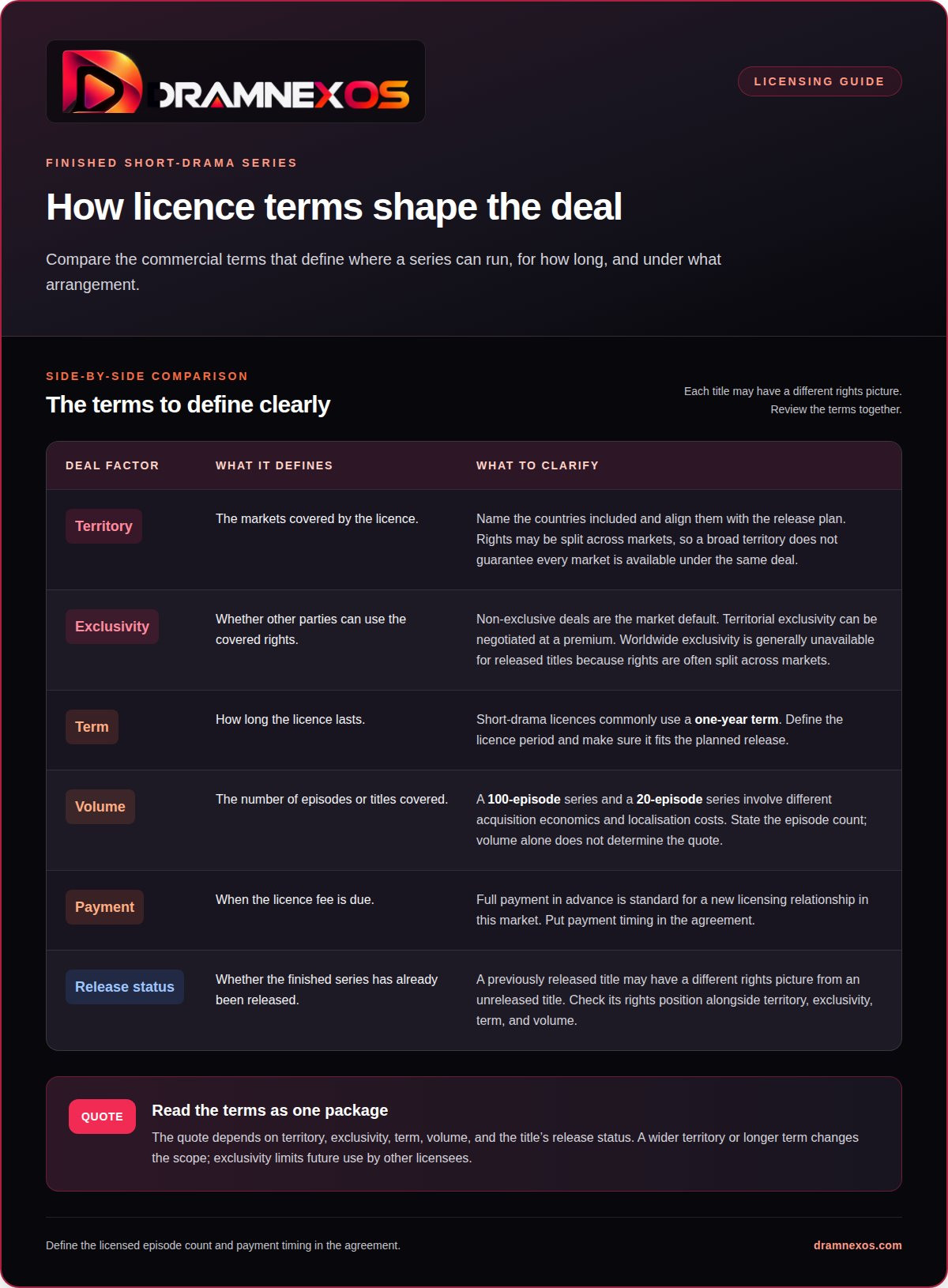
Territory identifies the markets covered, while the term sets the licence period. Short-drama licences commonly use a one-year term. Define whether the grant covers the United States alone or additional territories, and align those rights with your release plan. Geographic scope matters because rights to a title may be split across markets. A broad territory does not automatically mean every market is available under the same deal.
How do exclusive and non-exclusive licences compare?
An exclusive licence prevents other parties from using the rights covered; a non-exclusive licence allows the rights holder to license them to others. Non-exclusive deals are the market default and a sensible baseline for many buyers. Territorial exclusivity can be negotiated at a premium when control in a specific market matters. Worldwide exclusivity is generally unavailable for released titles because rights are often split across markets. Define exclusivity by territory and permitted use, not by a broad label alone.
How do episode volume and payment terms affect the deal?
Volume describes how many episodes or titles the deal covers, while payment terms set when the fee is due. A hundred-episode series and a twenty-episode series involve different acquisition economics and localisation costs. Full payment in advance is standard for a new licensing relationship in this market. State the licensed episode count and payment timing in the agreement. A larger package may affect the commercial discussion, but volume alone does not determine the quote.
Quotes depend on territory, exclusivity, term, volume, and the title’s release status. A finished series that has already been released may have a different rights picture from an unreleased title. Consider these factors together: a longer term or wider territory changes the scope, while exclusivity limits future use by other licensees. This gives both sides a clear basis for defining the deal without treating any one term as the whole price.
How do you access a catalogue and make a licensing inquiry?
A catalogue turns a broad content search into a shortlist of specific titles. A useful inquiry links each title to your intended audience, release platform, and rights requirements.
A licensing provider can match your brief with finished titles, coordinate an inquiry with a producer or distributor, and help clarify rights, terms, and delivery. The process typically moves from a title shortlist to a rights discussion, then to an agreement and delivery planning.
In the United States, buyers may include short-drama app operators, streaming services, broadcasters, and social-media publishers. The right buyer depends on the planned release: an app operator may need episode-by-episode streaming rights, while a broadcaster may need broadcast rights. Social-media distribution is a separate use to specify in the licence, not an automatic extension of streaming permission.
Make your inquiry useful by describing the release plan and the content you need. For example, a buyer launching a vertical-drama app can identify the target territory, preferred genres, language needs, and expected episode volume. This gives a provider a concrete basis for narrowing the catalogue instead of sending an unfocused list.
- Title fit: Match genre, premise, episode count, and format to the intended audience.
- Rights scope: Identify the platform, territory, term, and distribution uses for the inquiry.
- Materials: Establish which episodes, language assets, and promotional materials are part of delivery.
- Commercial terms: Connect the requested volume and exclusivity to the proposed licence.
After you select a title, the provider can coordinate discussions with the rights holder and help define the agreed scope in the licence. The delivery plan should link each file and accompanying material to the selected title. This keeps the handoff aligned with the intended release, whether for an app launch or a broadcast schedule.
Catalogue access is most useful when it supports a real acquisition decision. A focused inquiry gives the producer or distributor a clear picture of the intended use, while a title-specific shortlist lets the buyer compare story fit and rights scope together.
What should a finished microdrama catalogue include?
A catalogue is more than a title count. It helps buyers find finished stories that fit a release plan, audience, and viewing format. One licensor describes a collection of over 2,000 rights-cleared short-drama titles. A large selection only helps when its records make individual titles easy to assess.
Episode count and runtime affect how a series fits an app’s release schedule. Chinese micro-dramas (duanju) are typically shot vertically in 9:16, with episodes of about one to two minutes. Series often run about 20 to 100 episodes, and many commercial titles fall in a 60–100 episode range (Wikipedia: Duanju; CNA). Those ranges help distinguish a long, frequent-unlock format from a shorter story with fewer instalments.
Format matters too. Short drama is commonly produced in portrait 9:16, while some titles use 16:9 footage reframed for portrait viewing. A catalogue should make that distinction visible. A vertical-native series and a reframed title can feel different on a phone, even when both appear in a portrait player.
Useful catalogue records link creative details to acquisition needs. A buyer can sort or shortlist titles by:
- Story: Genre, premise, and audience fit, such as romance or suspense.
- Structure: Episode count and runtime, which shape release pacing.
- Format: Native portrait or reframed landscape footage.
- Rights: Available territories, platforms, and exclusivity terms.
- Materials: Language assets and delivery elements relevant to localisation.
Use those details to narrow the catalogue before evaluating a licence. For example, an operator planning a portrait-first app can prioritise native vertical titles, then compare story fit and episode structure. A buyer planning to dub a title can also identify whether it needs M&E audio stems. This turns a broad catalogue into a practical shortlist.
Explore finished short-drama catalogue options when you’re ready to move from title discovery to licensing inquiries.
How can Dramnex OS help you license finished series?
Dramnex OS runs a short-drama content marketplace where operators can license finished series from studios and creators, and suppliers can list titles and get paid per deal. Use it to pursue titles that fit your territory, platform and audience, then run those titles on your own branded storefront with coins, VIP, episode unlocks and analytics.
Viewers get a branded web app they can install from the browser as a PWA. Dramnex OS does not provide native iOS or Android apps, and it does not list apps on the App Store or Google Play. There is a free 7-day trial with no card. Trial storefronts show a “Made with Dramnexos.com” watermark, which comes off on a paid plan. Plans are Creator at $49/month, Starter at $149.99/month, Launch at $399/month and Studio at $999/month, plus a 5% platform fee on collected viewer payments (0% during the trial). See current pricing. Viewer payments go to the operator’s Stripe account once Stripe is connected. Until then, Dramnex OS can collect payments and pay out by Wise (including to a Pakistani bank in PKR), Payoneer, PayPal, or bank transfer. Stripe’s processing fee is separate.
You can open the self-serve demo to see a storefront, or start the trial when you are ready to test licensing and playback together.
What should you do after you license a title?
Connect the acquisition to a programming plan: what role the series plays in your slate, how it fits the audience, and what release sequence you will use. That gives the licence a purpose beyond adding a title to a catalogue. Then align the viewing experience — free episodes as a hook, then coins, unlocks or VIP — with the rights you actually bought.
Related reading
FAQ
Frequently asked questions
What does licensing a finished short drama series mean?
Licensing means the rights holder authorises a buyer to use a completed series under agreed terms, rather than commissioning its production. The deal should define permitted distribution, territory, duration, exclusivity, platforms, payment and delivery materials.
What are typical licensing fees for a finished short drama series in the United States?
There is no standard published fee. A quote depends on territory, exclusivity, term, episode volume and whether the title has already been released. Ask for a quote against a written rights package, and do not treat another buyer’s rumour as a price list.
How are licensing fees calculated based on episodes, viewers, territory, and exclusivity?
There is no single formula. Episode volume, territory, exclusivity, term and the title’s release status all affect the quote. If viewer numbers matter to the deal, define the audience measure and how it will be counted before you agree terms.
What contract terms should a short drama series licensing agreement include?
Specify the licensed title, permitted platforms, territory, term, exclusivity, episode count, payment timing and delivery items. Include language materials and say how promotional clips will be handled, including whether a trailer is covered separately from full-episode streaming.
How do exclusive and non-exclusive licenses compare?
An exclusive licence reserves the defined rights for one licensee; a non-exclusive licence lets the rights holder grant those rights to others. Non-exclusive terms are a practical baseline when you do not need market control. Exclusivity usually costs more and should be limited to the territory and platforms you will actually use.
What delivery materials do buyers usually require?
Requirements depend on the release and localisation plan. Buyers commonly specify episode masters, captions or subtitles, artwork, metadata and audio materials. Short drama is commonly produced in 9:16; if you plan to dub, specify M&E audio stems in the delivery schedule.
Newsroom by email
Get new articles in your inbox
Guides on launching and monetising your vertical-drama business. Confirm your address once, and we’ll email you when a new article is published.
Launch your own
Your own branded streaming app, live in minutes
Dramnexos is the white-label streaming operating system for vertical drama: your brand, your domain, coins, VIP and episode unlocks — with a free storefront to start and a licensing marketplace for finished series.