
guides
Mobile Drama App Development Cost and What Shapes the Price
Mobile drama app development cost depends on whether you commission a custom native build, a web-plus-mobile product, or a white-label storefront — plus video delivery, rights, testing and marketing. A hosted web app can shorten the build, but it does not remove catalogue or launch work.
Mobile drama app development cost depends on whether you commission a custom native build, a web-plus-mobile product, or a white-label storefront, plus video delivery, rights, testing and marketing. A custom web and mobile streaming MVP is often estimated at about five to eight months, before content and marketing (Kanopy Labs), and quotes still vary widely by scope. A hosted platform can shorten the build, but it does not remove catalogue, payment and launch work.
Dramnex OS is the hosted PWA path, not a native App Store or Google Play build. There is a free 7-day trial with no card. Trial storefronts show a “Made with Dramnexos.com” watermark, which comes off on a paid plan. Compare that route with short drama app development cost in 2026 and vertical video app costs and timelines.
Key Takeaways
- Estimate the build by mapping required features to development hours and rates, rather than relying on a broad app-cost average.
- Plan for ongoing security, hosting, and third-party service expenses alongside the initial build.
- Allocate budget across planning, design, development, testing, and launch to keep the project’s scope and spend visible.
- Control costs by validating the core experience early and delaying complex features until they’re needed.
Table of contents
- How much does it cost to develop an app in 2026?
- What do security, compliance and third-party services add to the price?
- How should you allocate the budget across development stages?
- How can you keep mobile app development costs under control?
- How Dramnex OS changes the build-cost equation
How much does it cost to develop an app in 2026?
Apps with richer features, more integrations, and greater infrastructure demands require a larger build budget.
How do you estimate costs from hours and rates?
A typical estimate starts with the hours required for each feature, multiplied by the rates for the people building it.
Break the work into design, backend, payments, and testing before estimating. This reveals which features drive costs instead of burying the effort in one total.
How do app models change the cost?
Native apps are built for a specific operating system, while cross-platform apps share a codebase across platforms. Separate native iOS and Android builds require more work; a shared cross-platform codebase can reduce duplication.
Hybrid apps combine web technologies with app packaging, while web apps run in a browser. Their costs depend on interface requirements, integrations, and device features such as notifications.
What do backend and infrastructure costs include?
The backend manages accounts, episode access, payment logic, and data exchange through APIs. Every integration adds development and testing work.
Streaming demand also shapes the design: video delivery, database activity, and simultaneous viewers all affect capacity needs. A low-traffic launch and a platform designed for rapid growth require different infrastructure. Include hosting, API usage, and scaling in the estimate, not just app coding.
What should you budget for marketing and post-launch work?
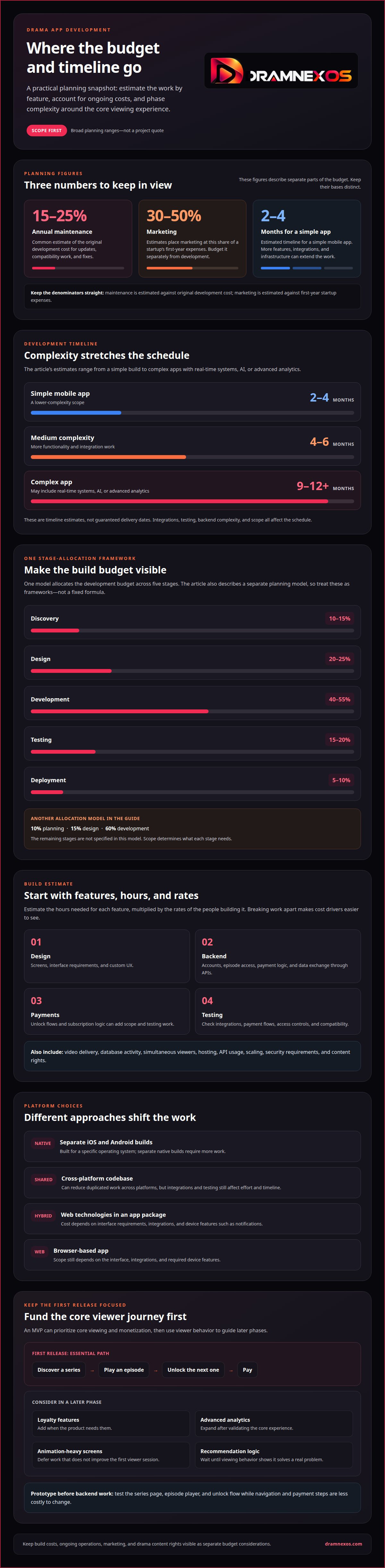
Launch isn’t the final budget line. Annual maintenance is often planned at around 20% to 30% of the original development cost each year, covering updates, compatibility work, and fixes (Muvi, on OTT platform costs). Set aside room for that ongoing work from the start.
Marketing is a separate expense from product development, and it can consume a large share of first-year cash, but published 30–50% rules of thumb are not a substitute for your own launch plan. Treat marketing as its own budget, alongside maintenance and infrastructure. That separation makes the build estimate more useful and keeps launch spending from quietly consuming the funds needed to support the app.
What do security, compliance and third-party services add to the price?
Short-form drama app costs rise with video delivery, episode unlocks, payment logic, user accounts, and analytics. Each feature adds design, development, and testing work. Security requirements, API connections, and custom UX design also affect scope.
The exact price depends on your features, backend complexity, security requirements, integrations, and timeline. A project quote provides a figure for your specific scope.
These broad ranges reflect different project scopes, not a fixed price for a drama app. A custom interface or more complex payment flow can place a project in a higher complexity tier.
Backend architecture determines how accounts, episodes, payments, and viewing data work together. A simple API connection has a narrower scope than a system coordinating subscription logic, third-party services, and multiple user roles. React Native can support a shared cross-platform codebase, but integrations and testing still affect the timeline.
Timelines also track complexity. A simple mobile app is estimated at 2-4 months; medium-complexity development at 4-6 months. Complex apps may take 9-12 or more months, especially when they include real-time systems, AI, or advanced analytics.
Ongoing costs can emerge after launch. Hosting, API usage, compatibility updates, and security patches require continued work. Key risks include weak access controls, exposed user data, unreliable integrations, and infrastructure that can’t handle viewing demand.
To compare custom development with a platform, review Dramnex OS plans alongside your feature and integration needs.
How should you allocate the budget across development stages?
Build an estimate around the product scope and the work behind each phase. One model assigns 10-15% to discovery, then budgets design, development, testing, and launch separately.
Drama content has its own budget. Licensing finished series depends on title rights, exclusivity, and deal terms; producing original episodes depends on the production scope. The cost depends on the agreed scope and licensing terms, so a quote is needed for an exact figure.
How should you budget an MVP and phase the rest of the work?
An MVP funds the core viewing and monetization experience first, with other features added in later phases. This limits initial scope and lets viewer behavior inform what comes next. For example, start with streaming and episode access, then consider loyalty features or advanced analytics in a later phase. A calculator can provide an early estimate, but the feature list and technical requirements determine the actual allocation.
How do budgets change with product scale?
These tiers reflect different functionality, integrations, and scale requirements, not interchangeable quotes. Choose the tier that matches the product you plan to launch.
For development stages, one allocation model puts 10% into planning, 15% into design, and 60% into development. Another model sets discovery at 10-15%, design at 20-25%, development at 40-55%, testing at 15-20%, and deployment at 5-10%. Treat these as planning frameworks, not a formula; scope changes the share each stage needs.
A streaming budget needs to account for video delivery, payment logic, and content rights as well as app development. Flutter can support a shared codebase, but it doesn’t eliminate backend, testing, or licensing work. Keep those costs visible in the estimate. Separate build costs from ongoing operations, then prioritize features that validate the viewing and payment model before expanding the platform.
How can you keep mobile app development costs under control?
Reduce app spending by deferring work that doesn’t improve the first viewer session. Map each feature to an action: discover a series, play an episode, unlock the next one, or pay. Keep those paths in the first release. Delay animation-heavy screens and recommendation logic until viewing behavior shows they solve a real problem.
Prototype key screens before backend work begins. A clickable flow can reveal confusing navigation or payment steps while changes are still less costly. Test the series page, episode player, and unlock flow. Clear mockups also give designers and developers a shared target, reducing avoidable rework during implementation.
Choose the app structure around how viewers will use the product. Combining web and mobile development in one project can cost less than two fully independent projects when the storefront and app share core journeys, though the saving depends on scope and is not a fixed percentage. Separate native builds may make sense when platform-specific behavior is central to the experience.
Keep integrations modular. Start with essential services for sign-in, payments, video delivery, and analytics; add optional connections only when they meet a defined need. Reuse proven components for common functions such as dashboards and account access. This limits custom development without forcing every feature into one tightly coupled backend.
Protect the ongoing budget, too. Every integration brings setup, testing, and maintenance work. Track the purpose and owner of each service, and remove unused connections instead of carrying them forward. For example, launch with basic viewing analytics, then expand reporting when your team has a clear decision it needs to support.
Content decisions also affect scope. Licensing finished series and producing original dramas involve different workflows, rights, and delivery requirements. Define your catalog approach early, then align app features with it. If launch depends on licensed titles, plan the content pipeline alongside episode pages and playback instead of adding those requirements after development.
How Dramnex OS changes the build-cost equation
Viewers get a branded web app they can install from the browser as a PWA. Dramnex OS does not provide native iOS or Android apps, and it does not list apps on the App Store or Google Play. There is a free 7-day trial with no card. Trial storefronts show a “Made with Dramnexos.com” watermark, which comes off on a paid plan. Plans are Creator at $49/month, Starter at $149.99/month, Launch at $399/month and Studio at $999/month, plus a 5% platform fee on collected viewer payments (0% during the trial). See current pricing. Viewer payments go to the operator’s Stripe account once Stripe is connected. Until then, Dramnex OS can collect payments and pay out by Wise (including to a Pakistani bank in PKR), Payoneer, PayPal, or bank transfer. Stripe’s processing fee is separate. Done-For-You Launch is optional setup help: branding, custom domain, catalog onboarding, and monetization configuration. It does not include native app development or store listings.
You can start a free 7-day trial, open the self-serve demo, or browse finished series on the content marketplace.
Related reading
FAQ
Frequently asked questions
How much does it cost to develop a mobile drama streaming app in the US?
There is no single figure. A custom native or web-plus-mobile product can run from a modest MVP to a much larger budget, depending on playback, payments, rights and testing. A hosted white-label storefront is usually a monthly plan plus payment fees, which is a different cost shape, not a zero-cost launch.
What are typical costs by app complexity and feature set?
Costs rise with custom players, multi-platform native apps, complex entitlements, and heavy integrations. A catalogue, playback, accounts and one payment model cost less than adding live features, store IAP, and several TV platforms. Write the feature list first, then price the build against it.
How much do iOS and Android drama app development costs differ?
Two native codebases usually cost more than one shared web or cross-platform app. The gap depends on how much platform-specific playback and store billing you need. If you do not need store listings, a branded PWA can avoid that duplicated native work. Dramnex OS takes the PWA path and does not ship native apps.
How much do video hosting, CDN, and streaming costs typically run?
They scale with storage, encoding, and especially egress — how much video is actually watched. Get a quote against expected minutes delivered, not only against a title count. Budget this as an operating cost, not only as a launch line item.
How much does app maintenance and ongoing development cost per year?
A common planning range for an OTT product is about 20–30% of the original development cost each year, covering updates, compatibility work and fixes. That is a planning aid from industry vendors, not a quote for your stack. A hosted platform shifts much of that work into the subscription.
How long does it take to build a mobile drama app?
A custom web and mobile streaming MVP is often estimated at about five to eight months, before content and marketing, though quotes vary by scope. Some white-label vendors advertise a much shorter launch once branding, catalogue and payments are ready.
Newsroom by email
Get new articles in your inbox
Guides on launching and monetising your vertical-drama business. Confirm your address once, and we’ll email you when a new article is published.
Launch your own
Your own branded streaming app, live in minutes
Dramnexos is the white-label streaming operating system for vertical drama: your brand, your domain, coins, VIP and episode unlocks — with a free storefront to start and a licensing marketplace for finished series.