
guides
White-Label Vertical Drama Platform: Launch Without Building One
A white-label vertical drama platform lets you launch a branded short-drama service without building the player, payments and catalogue tools yourself. You still need rights, a format plan, and a monetization mix. Dramnex OS is that hosted path as an installable web app, not a native store listing.
A white-label vertical drama platform lets you launch a branded short-drama service without building the player, payments and catalogue tools yourself. You still need a format plan (often 9:16 episodes of about one to two minutes), rights to the titles, and a monetization mix of coins, VIP and ads. Dramnex OS is that hosted path as an installable web app, not a native App Store or Google Play listing.
There is a free 7-day trial with no card. Trial storefronts show a “Made with Dramnexos.com” watermark, which comes off on a paid plan. Done-For-You Launch is optional setup help: branding, custom domain, catalog onboarding, and monetization configuration. It does not include native app development or store listings. See white-label short drama apps and key features to look for in a white-label streaming app.
Key Takeaways
- Shape each series around mobile viewing, with pacing and cliffhangers that give viewers a reason to continue.
- Plan your content library, brand, storefront, and app experience before choosing a launch route.
- Match each revenue option to how viewers access episodes, then use performance data to refine the mix.
- Compare platform features such as branded storefronts, analytics, and content licensing to find the setup that fits your launch.
Table of contents
- What format and episode lengths do vertical micro-dramas use?
- What are the steps to launch a micro-drama OTT app?
- How do coin packs, subscriptions and ads work together?
- What features should a white-label vertical drama app include?
- How to launch on Dramnex OS without building the stack
What format and episode lengths do vertical micro-dramas use?
Vertical micro-dramas tell serialized stories through short, mobile-first episodes. Episodes are typically short, while seasons can contain many episodes. The 9:16 vertical video format fills a phone screen, keeping faces, reactions, and captions easy to follow. Each installment should advance the story, not just cut a longer scene into pieces.
Build each episode around one clear turn: a reveal, decision, conflict, or new obstacle. Place a strong hook early; a cliffhanger within the first 60 seconds can give viewers a reason to continue. For example, end a confrontation with a character discovering a hidden message, then open the next episode with its consequence.
Discovery begins with the first frame and the way each series is presented. TikTok-style browsing encourages quick sampling, while a dedicated drama app can organize stories by genre, theme, or series. Use a clear title, concise synopsis, and distinctive cover art. ReelShort is one example of the short-drama app category, but your service needs its own brand identity.
Free episodes can lower the barrier to sampling a story. One free-first approach offers the first 3 episodes at no cost, then places later episodes behind payment or ads. Advertising can support free viewing, while a clear episode boundary gives viewers a natural choice to watch an ad, unlock the next installment, or stop.
Set the player for portrait viewing on Android and other phones. Keep playback controls, captions, and episode navigation easy to reach without obscuring the action. A useful example is a simple next-episode prompt after the ending. Test the 9:16 picture and text placement on small screens before publishing.
Organize every series with a consistent episode order, title, synopsis, artwork, and access setting. Group episodes into seasons so viewers can see what comes next. Label a season finale clearly and link it to the following season when available.
Use a publishing calendar to manage release order and availability. Before publishing, confirm that each episode has the correct series, sequence, thumbnail, and free or paid setting. This simple workflow keeps stories easy to browse and helps prevent a missing installment from disrupting the viewing experience.
What are the steps to launch a micro-drama OTT app?
In the United States, operators can compare white-label OTT platforms with custom app development. Evaluate branding, streaming, and publishing controls, as well as risks such as vendor lock-in, feature limits, migration friction, and unclear ownership of app accounts or audience data.
What do platform costs and delivery timelines look like?
A launch timeline is the time needed to configure, test, and release your streaming app. It matters because content uploads, branding, and app development must line up before launch. Custom development typically takes 6-12 months; a white-label vertical drama app can be customized and launched in 6-10 weeks. Cost depends on customization, app scope, integrations, and the work needed to prepare the player and storefront.
For a practical launch, define your audience and storytelling model first. Prepare series metadata, upload episodes, set viewing access, and test playback across devices. A release checklist can catch gaps before viewers enter the app.
What does platform ownership actually mean?
Platform ownership means knowing which parts of the app and audience relationship you control. A branded interface alone does not guarantee control over app accounts, customer data, or future migration. Before launch, establish responsibilities for your domain, branding assets, content records, user information, and app-store accounts. Keep current copies of episode files and metadata so publishing does not depend on one person’s access.
A white-label setup can reduce app development work, but the platform terms still matter. Review how feature changes, data access, and account administration work. For instance, make clear within your team who can update a series description or change an episode’s access setting.
- Define the audience, content categories, and launch library. Match the app’s navigation to how viewers browse entertainment.
- Set the brand, domain, storefront, and app-player requirements. Decide how viewers discover a series and continue watching.
- Upload episodes with accurate titles, artwork, sequence, and access settings. Test the full journey from discovery through playback.
- Run a small internal launch review. Check Android playback, account access, payment flow, and episode order before promoting the app.
Reduce launch risk by documenting platform access and testing a complete viewer journey. Compare white-label app launch options when you’re ready to map those requirements to a branded streaming setup.
How do coin packs, subscriptions and ads work together?
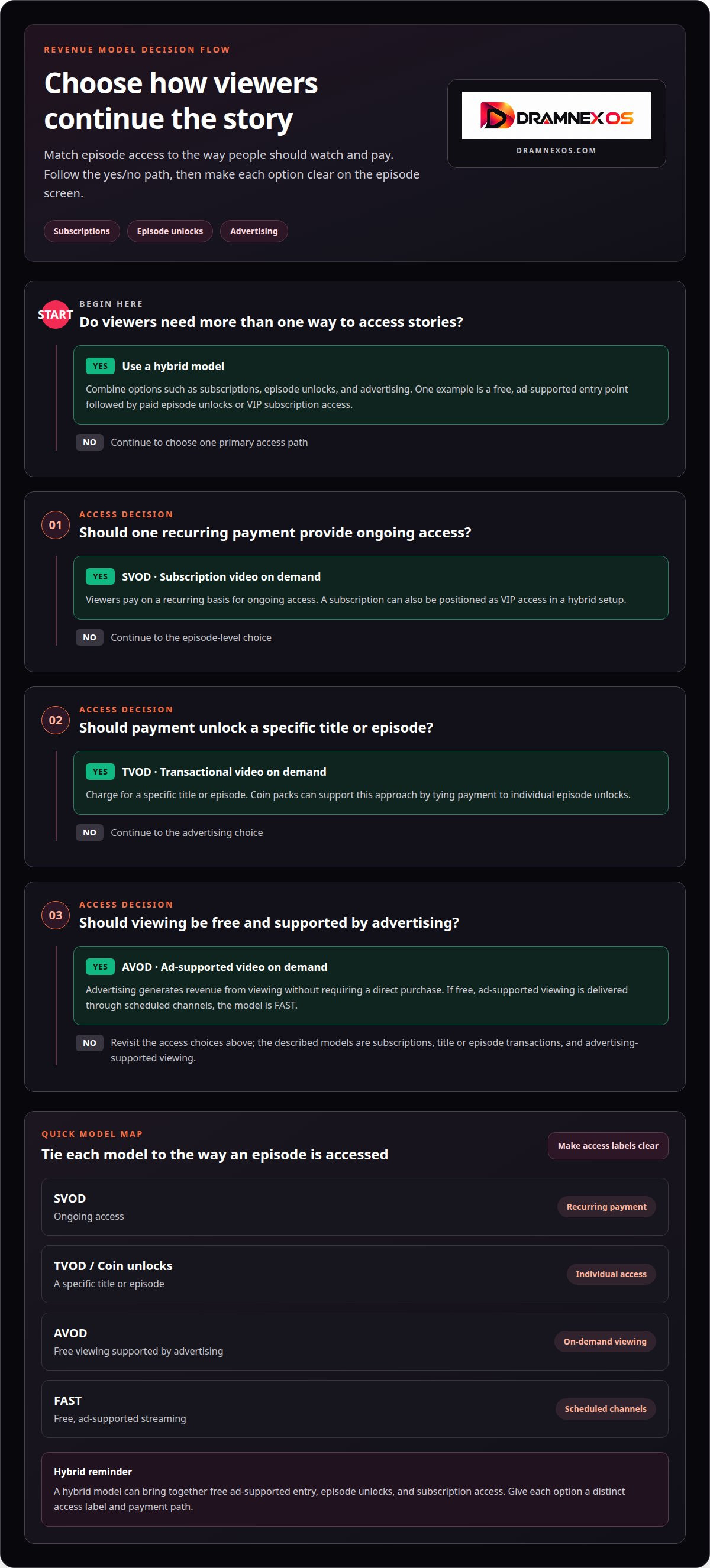
Choose a revenue model that matches how viewers want to continue a series. SVOD, AVOD, TVOD, and FAST each offer a different way to pay for or watch content.
When does a hybrid monetization model make sense?
A hybrid model combines payment methods, such as subscriptions, episode unlocks, and advertising. This gives viewers more than one way to access stories instead of forcing a single option. For example, offer a free, ad-supported entry point, then let viewers unlock episodes or subscribe for VIP access. Make each option clear on the episode screen so the choice does not interrupt the story.
SVOD, or subscription video on demand, gives viewers ongoing access for a recurring payment. AVOD offers video supported by advertising, while TVOD charges for a specific title or episode. FAST provides free, ad-supported streaming through scheduled channels. These models can work together, but each needs a distinct access label and payment path.
How does subscription monetization work?
Subscription monetization provides ongoing access in exchange for recurring payment. It can make sense when a growing library gives subscribers a reason to return to multiple series. A VIP tier might include selected episodes, while other stories remain available through individual unlocks. Explain exactly what is included before viewers subscribe.
Track subscription starts alongside episode completion and return viewing. If viewers sample one series and stop, a broad subscription may not fit their behavior. Use viewing analytics to identify titles that hold attention, then adjust what the tier includes. Do not promise unlimited access if the subscription covers only selected content.
How do coin packs and advertising work?
Coin packs let viewers buy coins and spend them to unlock episodes individually. They can work well when a cliffhanger builds immediate interest in the next installment. Display the coin cost before the unlock and make the remaining balance visible, so viewers understand the exchange before choosing.
Advertising can support free viewing through placements between episodes or at natural breaks. Test ad timing against episode completion, then favor placements that interrupt fewer stories. For example, pair an ad-supported episode with a coin unlock option. Compare viewing and purchase patterns to decide which mix works best for each series.
What features should a white-label vertical drama app include?
A white-label vertical drama platform needs more than a logo and portrait video. The right features connect viewing, content operations, and revenue while making it easy to find the next episode. Start with the viewer experience: make series discovery, episode details, and playback easy to reach. Keep navigation familiar across the storefront and app.
The player shapes the viewing experience. Prioritize portrait playback, clear captions, responsive controls, and a visible route to the next episode. Adaptive bitrate streaming can help playback adjust on weaker 3G/4G networks. Test the player on different screen sizes and connection conditions. Check that controls don’t cover dialogue or key action.
Build a content workflow around each series, not just its video files. Operators should be able to organize episodes, update descriptions, manage artwork, and set access rules. Before release, a publishing checklist can verify the title, episode order, thumbnail, and free or paid status. This reduces catalog errors and keeps the viewing path intact.
Monetization features should match the choices presented to viewers. Coins can unlock individual episodes, VIP access can bundle content, and ads can support free viewing. Analytics help operators see how viewers move from discovery to playback, where they stop, and which stories hold their attention. Use those patterns to refine placement and access settings, rather than assuming every series performs the same way.
Brand control spans the storefront, app icon, and account experience. A consistent name and visual style help viewers recognize your service from discovery through playback. Before launch, test a complete journey on Android: open a series, play an episode, and continue to the next installment. Treat each screen as part of one product, not a separate feature.
- Check discovery, playback, episode access, and account screens as one flow.
- Review analytics against series completion and return viewing.
- Test the player on varied screen sizes and weaker connections.
Use these checks to shape your platform requirements. Explore branded streaming features for a setup that brings storefront, monetization, and analytics together.
How to launch on Dramnex OS without building the stack
Viewers get a branded web app they can install from the browser as a PWA. Dramnex OS does not provide native iOS or Android apps, and it does not list apps on the App Store or Google Play. There is a free 7-day trial with no card. Trial storefronts show a “Made with Dramnexos.com” watermark, which comes off on a paid plan. Plans are Creator at $49/month, Starter at $149.99/month, Launch at $399/month and Studio at $999/month, plus a 5% platform fee on collected viewer payments (0% during the trial). See current pricing. Viewer payments go to the operator’s Stripe account once Stripe is connected. Until then, Dramnex OS can collect payments and pay out by Wise (including to a Pakistani bank in PKR), Payoneer, PayPal, or bank transfer. Stripe’s processing fee is separate. Done-For-You Launch is optional setup help: branding, custom domain, catalog onboarding, and monetization configuration. It does not include native app development or store listings. Dramnexos RISE 100 offers selected filmmakers, AI storytellers and digital creators two months of Starter access at no charge, after which they can stay on Starter, change plan, or cancel.
You can start a free 7-day trial, open the self-serve demo, or browse finished series on the content marketplace.
Related reading
FAQ
Frequently asked questions
What is a white-label vertical drama platform?
It is a ready-made storefront for portrait, short-form dramas that you brand as your own. The vendor provides playback, catalogue, accounts and payments; you provide the brand, the titles and the operating plan.
What features should a vertical drama platform include?
A 9:16 player, episode-level catalogue tools, coin and VIP monetization, accounts, analytics, and a custom domain on a paid plan. Native app-store listings are optional and are not included with Dramnex OS, which ships an installable web app only.
How much does it cost to launch and operate a white-label vertical drama app?
Expect a platform subscription, payment processing, a platform fee if the vendor charges one, plus content, marketing and delivery. Dramnex OS plans start at Creator $49/month, with a 5% fee on collected viewer payments (0% during the 7-day trial).
How do vertical drama platforms handle subscriptions, coins, and ads?
Most let you combine a VIP plan, coin packs for episode unlocks, and sometimes advertising. Set rules so viewers can tell which option applies to a title, and keep entitlements in sync with payments.
How do you set up and launch a white-label vertical drama platform?
Choose a vendor, add branding, connect a domain if included, load licensed titles, set prices, connect payouts, test on real phones, then launch. You can start on Dramnex OS with a free 7-day trial, or look at Dramnexos RISE 100 if you are eligible for two months of Starter access.
What video formats, episode lengths, and app-store requirements apply?
Vertical micro-dramas are commonly delivered in 9:16, with episodes of about one to two minutes. App-store review, screenshots and SDK rules apply only if you ship a native store app. Dramnex OS does not list apps in the App Store or on Google Play, so those store requirements do not apply to its PWA.
Newsroom by email
Get new articles in your inbox
Guides on launching and monetising your vertical-drama business. Confirm your address once, and we’ll email you when a new article is published.
Launch your own
Your own branded streaming app, live in minutes
Dramnexos is the white-label streaming operating system for vertical drama: your brand, your domain, coins, VIP and episode unlocks — with a free storefront to start and a licensing marketplace for finished series.