
Home › Newsroom › drama licensing
drama licensing
List Drama Series for Licensing by Territory and Deal Terms
A list of drama series for licensing is only useful once you know which rights each title still has free: territories, service type, term and exclusivity. Here is how to get a catalogue, read it by territory and deal terms, and what to write into the licence.
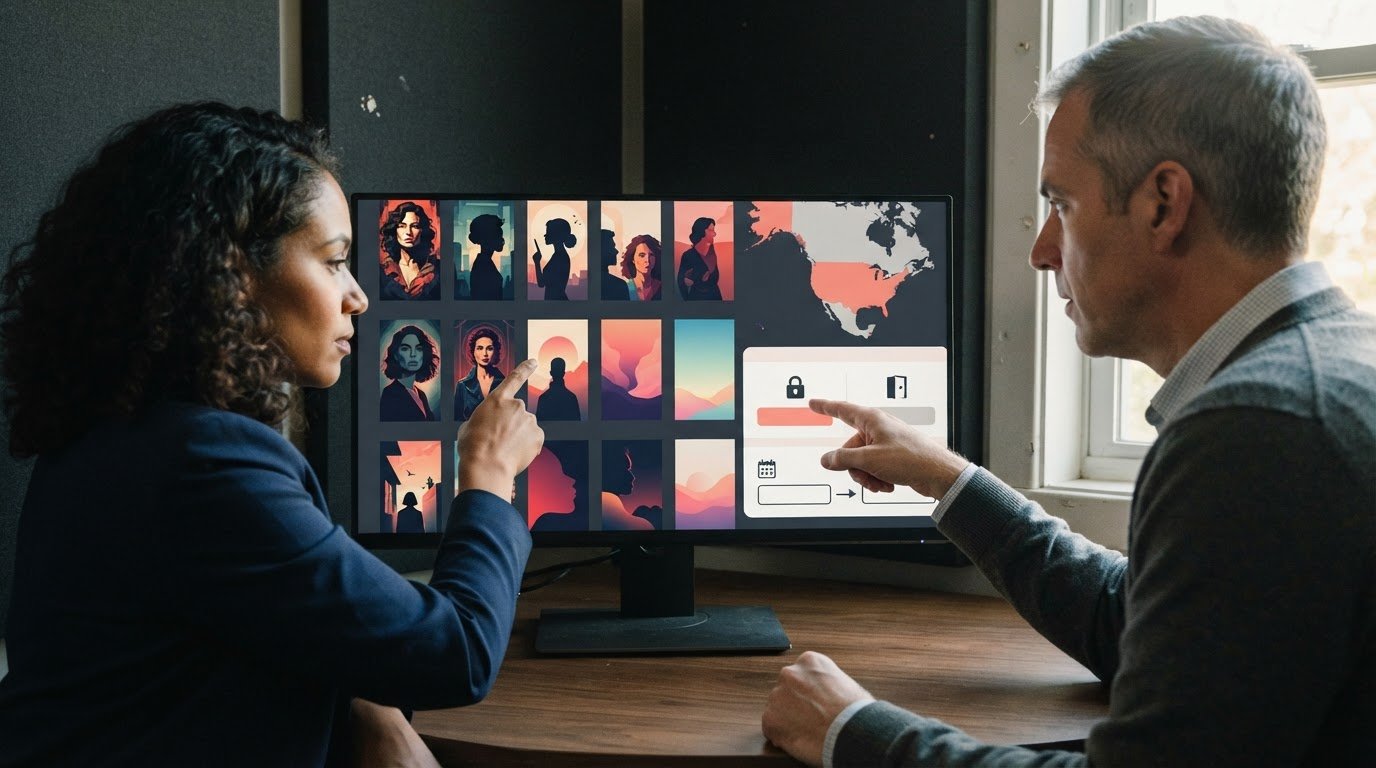
A list of drama series for licensing is only useful once you know which rights each title still has free: the territories, the type of service, the term and whether the licence is exclusive. Ask every seller for a catalogue that shows those four facts per title, compare offers only on the same rights package, and write each country into the agreement by name. For a first catalogue, a non-exclusive licence for the countries you actually serve is usually the quickest deal to close.
This guide explains how to get a catalogue of drama series to license, how to read it by territory and deal terms, and what to put in writing before you pay. If you want to browse finished short-drama series now, the Dramnex OS content marketplace lists titles at fixed prices. Licence terms and prices vary by deal, and nothing here is legal advice; have a lawyer review any agreement you sign.
Key takeaways
- A title list means little without the rights behind each title: territories, service type, term and exclusivity.
- Name every country in the licence. Labels like "English-speaking markets" leave room for disputes.
- Exclusive rights cost more and may not be available for series already released elsewhere; non-exclusive rights are the usual starting point.
- Fees depend on the whole rights package, so only compare offers covering the same scope.
How do you get a list of drama series available for licensing?
There are three common sources, and each gives you a different kind of list:
| Source | What the list looks like | What to check |
|---|---|---|
| Studios and creators | Their own titles, often with the most detail | Whether they still hold the rights for your territories |
| Distributors and sales agents | Titles from many rights holders, grouped by genre or market | That they are authorised to license each title in your territories |
| Licensing marketplaces | Public listings with prices or standard terms | The rights summary and the licence each listing comes with |
Whatever the source, ask for the same package per title: synopsis, genre, language versions, episode count and runtimes, aspect ratio (9:16 vertical or 16:9), sample episodes, and a rights summary showing which territories and service types are available and until when.
Ask the seller to separate titles that are available today from planned or upcoming ones. A catalogue that mixes them makes it hard to plan a release date.
How do you read a drama catalogue by territory?
Start with your own footprint: list the countries where your app will actually accept viewers and payments. Then check each title against that list.
- Name each country. Write the countries into the agreement individually, or use a clearly defined list such as ISO 3166-1 country codes. Broad labels like "worldwide excluding Asia" or "English-speaking markets" invite arguments later.
- Check what is already taken. A series that has been released on another platform may already be licensed in some of your countries. Ask for a list of earlier licences with territories, terms and exclusivity.
- Plan for geo-blocking. If you license the United States and Canada only, your app must stop viewers elsewhere from watching that title. Confirm you can do that before you agree to it.
- Split territories when it helps. A seller may offer exclusive rights in one market and non-exclusive rights elsewhere. Taking only the countries you serve keeps the fee tied to viewers you can actually reach.
What deal terms should a drama licence spell out?
A licence covers only what it names. Before you sign, make sure the agreement states:
| Term | What to write down |
|---|---|
| Titles and episodes | Series names and exact episode lists |
| Territory | Each included country, and any exclusions |
| Service type | Subscription, pay-per-episode or coins, ad-supported, free |
| Platforms | Web, app, TV, and whether it is your own branded service |
| Term | Start date (signature or delivery), end date and renewal |
| Exclusivity | Exclusive or non-exclusive, and its scope |
| Languages | Original language, and whether subtitles or dubs are included |
| Edits and promotion | Whether you may cut clips, trailers and posters for marketing |
| Delivery | File formats, resolution, artwork, captions and acceptance |
| Payment | Flat fee, revenue share or minimum guarantee, and due dates |
There is no single standard term or payment structure across the market. Pick a term that leaves room for setup and localisation: if the clock starts at signature but files arrive two months later, you have lost two months of your window.
Should you choose exclusive or non-exclusive licensing?
Exclusive licensing gives one buyer defined rights within an agreed scope. That scope can be limited by territory, type of service, language or period, so "exclusive" on its own is not enough. An exclusive U.S. subscription-streaming licence for two years is a precise grant; "exclusive rights" is not.
Non-exclusive licensing lets the rights holder license the same series to other buyers, including in your territory. You get less control over where viewers can watch it, but the fee is normally lower and the deal is simpler to close.
A practical rule of thumb:
- Exclusive makes sense for a series you plan to build your brand around and promote heavily.
- Non-exclusive fits a first catalogue, a test of a genre, or a series that has already been released elsewhere.
Either way, read the rights grant alongside its limits. A streaming licence does not include broadcast rights or the right to sublicense unless it says so.
What affects the licence fee for a drama series?
The fee follows the rights package and the title itself:
- Territory and exclusivity: more countries and exclusivity usually cost more.
- Term: longer terms usually cost more.
- Volume: a slate of many titles is often priced differently from a single title, so ask for both.
- Episode count and format: micro dramas commonly run 60 to 100 episodes of about 30 to 120 seconds each, according to Variety, but runtimes and episode counts differ by series.
- Localisation: subtitles and dubbing are often separate costs. Get a quote for the languages you need before you compare licence fees.
- Performance data: if the seller can share retention or paywall results from a previous release, it helps you judge the price.
Payment usually takes one of three shapes: a flat fee, a revenue share, or a minimum guarantee (a guaranteed floor payment, sometimes recoupable against a revenue share). Write down when each payment is due and what triggers it, such as signature or accepted delivery.
How does the Dramnex OS content marketplace work for buyers?
The Dramnex OS content marketplace is a fixed-price list of finished short-drama series. Operators browse the Content Store in their dashboard, preview up to two sample episodes of each title free, sign the standard Content Licence Agreement at checkout and pay by card. The licence is a defined, non-exclusive streaming licence for a term, and the title is copied into the buyer's library automatically. Rights holders list titles free, set their own prices and keep 75% of each sale; every title is rights-attested and reviewed before it appears.
To show licensed series to viewers, you also need a storefront. Dramnex OS gives you a white-label one with free episodes as a hook, then coins, episode unlocks and VIP subscriptions. Viewers watch in the browser and can install it to their home screen as a web app (PWA); Dramnex OS does not publish native iOS or Android apps or App Store and Google Play listings, and its Done-For-You Launch service does not include native app builds. Viewer payments go to your own Stripe account once you connect it; until then, Dramnex OS collects for you and pays out by Wise, Payoneer, PayPal or bank transfer. Plans are Creator $49 a month, Starter $149.99, Launch $399 and Studio $999, plus a 5% platform fee on collected viewer payments (pricing).
How can you try it?
Start the free 7-day trial, no card needed; the trial storefront shows a small "Made with Dramnexos.com" watermark until you pick a paid plan. To see what viewers get, open the self-serve demo, a sample app called CrownShorts. Questions about a specific catalogue or territory can go to the licensing team.
For more on the paperwork, read our guides on how to license a short drama series for your streaming app and finished short drama licensing terms, rights and delivery.
FAQ
Frequently asked questions
Can you license a drama series for one country only?
Yes. A licence can cover a single territory such as the United States. Name the country in the agreement and state the service type (for example subscription streaming), because a territory on its own does not define which platforms or uses are allowed. Your app must also be able to block viewers outside that territory.
How do I get a catalogue of drama series available for licensing?
Ask studios, distributors or sales agents for their catalogue, or browse a licensing marketplace. For each title, request the synopsis, episode count and runtimes, format (9:16 or 16:9), language versions, sample episodes and a rights summary showing which territories and service types are available and until when.
How much does it cost to license a drama series?
There is no single price. The fee depends on territory, exclusivity, term, service type, episode volume and localisation needs. Compare offers only when they cover the same rights. On the Dramnex OS content marketplace, rights holders set a fixed price per title, shown before checkout.
What is the difference between exclusive and non-exclusive licensing?
Exclusive licensing gives one buyer defined rights within an agreed scope (territory, service type, language or period), so no one else can carry the title within that scope. Non-exclusive licensing lets the rights holder license the same series to other buyers. Non-exclusive deals usually cost less and are quicker to close.
What is a minimum guarantee in a licensing deal?
A minimum guarantee is a guaranteed floor payment the buyer agrees to pay. It is sometimes recoupable against a revenue share, meaning the buyer pays the larger of the guarantee and the share. The agreement should state the amount, when it is due and whether it is recoupable.
Newsroom by email
Get new articles in your inbox
Guides on launching and monetising your vertical-drama business. Confirm your address once, and we’ll email you when a new article is published.
Launch your own
Your own branded streaming app, live in minutes
Dramnexos is the white-label streaming operating system for vertical drama: your brand, your domain, coins, VIP and episode unlocks — with a free storefront to start and a licensing marketplace for finished series.